The construction industry accounts for roughly 8% of global CO2 emissions, with cement production being the single largest contributor. In Malaysia, where construction activity continues to drive economic growth, the industry is looking for ways to build greener without sacrificing quality. Rice husk ash (RHA) is emerging as a powerful tool in this effort.
How RHA Improves Concrete
Rice husk ash is a pozzolanic material — it reacts with calcium hydroxide (a byproduct of cement hydration) to form additional cite compounds that strengthen the concrete matrix. When properly processed, RHA can:
- Increase compressive strength — Concrete with 10-15% RHA replacement of cement can achieve equal or higher 28-day compressive strength compared to conventional concrete.
- Improve durability — RHA fills micro-pores in the concrete matrix, making it more resistant to water penetration, chloride attack, and sulfate exposure.
- Reduce permeability — RHA concrete has significantly lower water absorption, making it ideal for structures exposed to aggressive environments like coastal buildings and water treatment facilities.
- Lower heat of hydration — Large concrete pours (dams, foundations) benefit from the lower heat generation of RHA-blended cement, reducing thermal cracking.
Optimal Replacement Ratio
Research shows that replacing 10-20% of Portland cement with RHA produces the best results. Beyond 20%, workability decreases and water demand increases. The sweet spot for most Malaysian applications is 10-15% replacement, which maintains workability while maximizing strength gains.
Quality Requirements
Not all rice husk ash is suitable for concrete. The key quality factors are:
- Silica content: Must be above 85% (amorphous silica preferred)
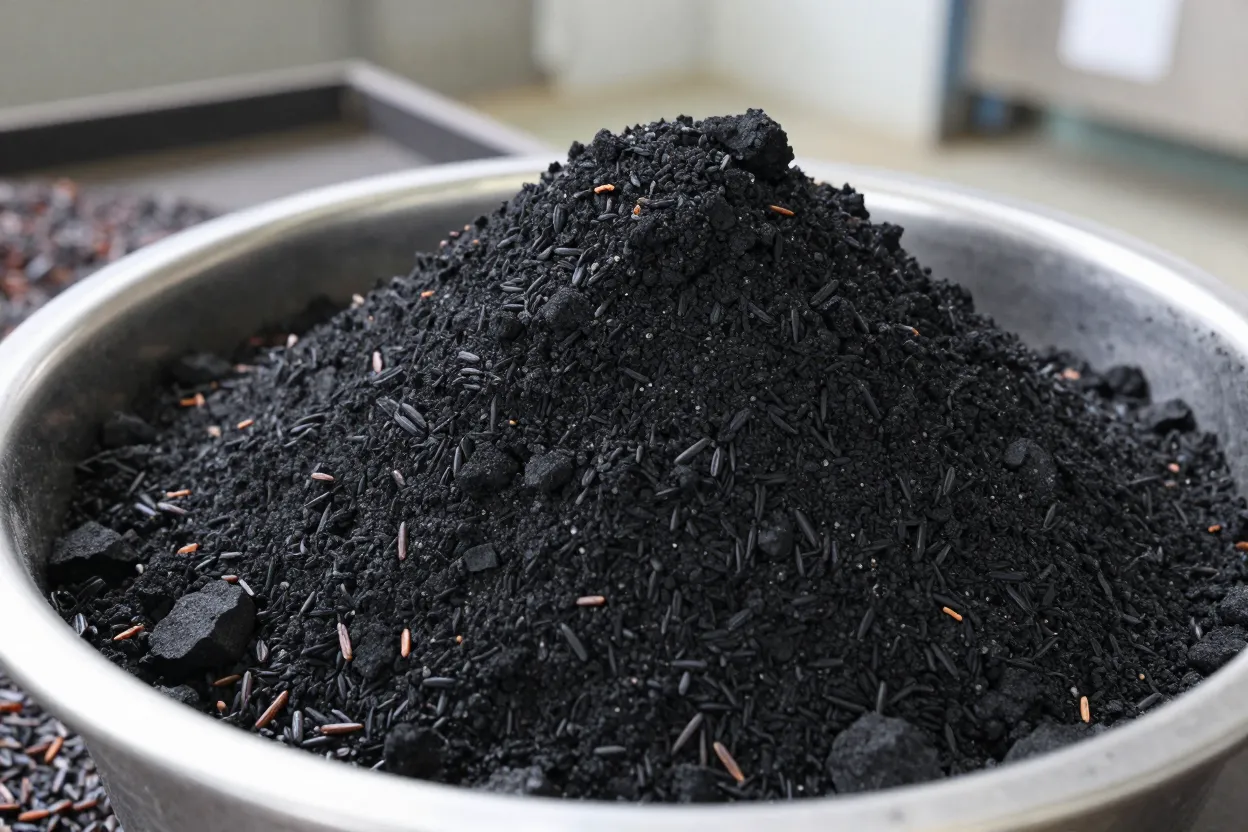
- Burning temperature: Controlled burning at 500-700°C produces amorphous (reactive) silica. Uncontrolled burning above 800°C creates crystalline (non-reactive) silica.
- Particle size: Must be ground to below 45 microns for effective pozzolanic reaction.
- Loss on ignition: Should be below 6%, indicating minimal unburned carbon.
Environmental Impact
Every tonne of RHA used in concrete replaces approximately 1 tonne of Portland cement — preventing roughly 0.9 tonnes of CO2 emissions. For a large construction project using 1,000 tonnes of cement, a 15% RHA replacement would save 135 tonnes of CO2. Additionally, using RHA diverts agricultural waste from landfills and open burning.
Supply from S&S Coco Trading
We supply quality rice husk ash sourced from Malaysian rice mills, processed at controlled temperatures to ensure high amorphous silica content. Our RHA meets the specifications required by concrete producers and ready-mix plants. Contact us for lab analysis reports, samples, and bulk pricing for your construction projects.