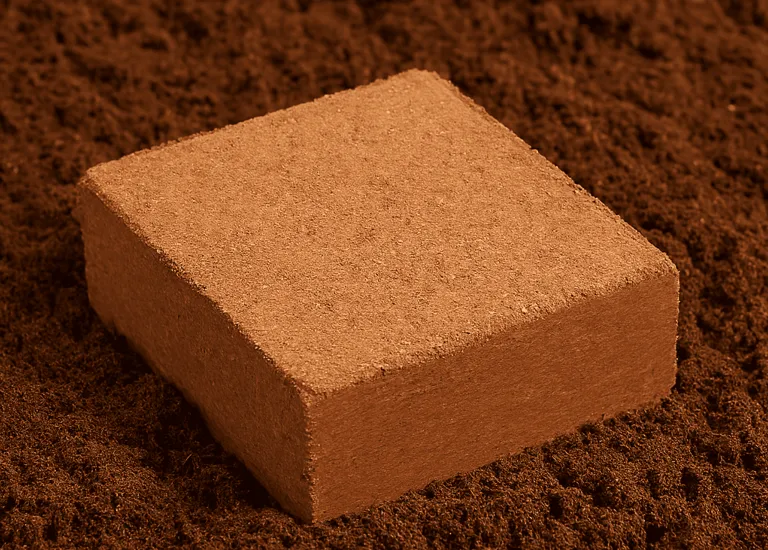
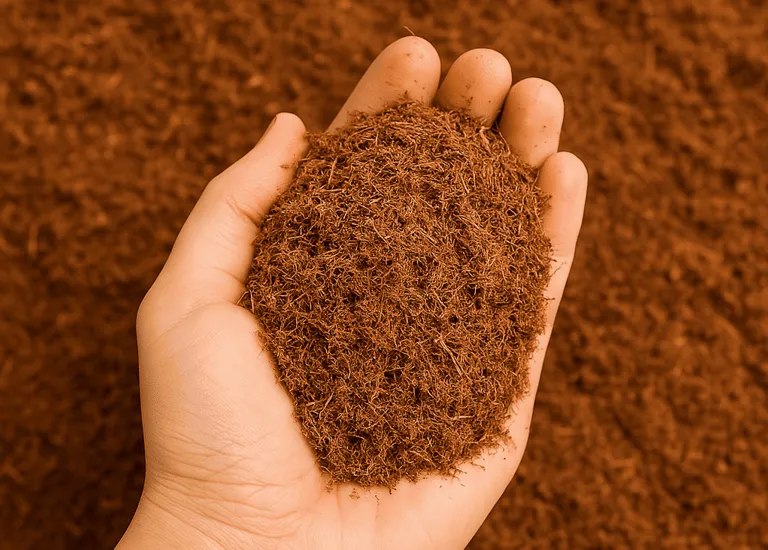
Cocopeat is sold in three broad states — raw, washed and buffered — and the price difference between them is not marketing. Each represents a different amount of processing, and choosing the wrong one is the most common and most expensive mistake in commercial cocopeat buying. This guide explains what each actually is, which one your crop needs, and what it costs you to get it wrong.
Raw (Unwashed) Cocopeat
Raw cocopeat is coir pith that has been extracted, dried and compressed with no salt treatment. It is the cheapest option and the most widely sold.
Because coconut husks are often retted in brackish or sea water, raw material can carry a significant salt load — sodium, chloride and high potassium. Wet it and those salts go straight into the root zone.
- Use it for — erosion control, industrial applications, soil bulking where salt is not critical, or where you will leach it heavily yourself before planting.
- Avoid it for — seedlings, fertigation, hydroponics, or any high-value crop.
Washed Cocopeat
Washed cocopeat has been flushed with fresh water to remove soluble salts, bringing the EC down to a level safe for sensitive plants. It costs more because washing consumes a lot of clean water and adds a drying step.
This is the workhorse grade for most commercial growing. If you are raising seedlings or running fertigation, washed low-EC material should be your baseline — it means the EC your roots see is the EC you dosed, not a hidden background load.
What washing does not do is fix the calcium problem. That needs buffering.
Buffered Cocopeat
Buffering is a treatment, usually with a calcium solution, that goes a step beyond washing. To understand why it matters you need to know how cocopeat holds nutrients.
Cocopeat has a high cation exchange capacity — it grips positively charged nutrients on its surface. In untreated material those sites are occupied by sodium and potassium. When you feed a calcium-rich solution the medium trades: it dumps sodium and potassium into your solution and locks up your calcium and magnesium.
Buffering pre-loads those exchange sites with calcium, so the swap has already happened before the plant arrives. Your feed then stays as you intended. The underlying chemistry is covered in our guide to cocopeat EC and pH.
- Essential for — tomato, capsicum, chilli, melon, strawberry and other calcium-sensitive crops, and any long-cycle fertigation crop.
- The symptom it prevents — blossom-end rot and tip burn that appear even when your feed chart says calcium was supplied.
Side-by-Side Comparison
| Grade | Salt load (EC) | Ca/Mg lock-up | Relative cost | Best suited to |
|---|---|---|---|---|
| Raw | High / variable | Yes | Lowest | Erosion control, industrial, soil bulking |
| Washed | Low | Yes | Medium | Seedlings, general fertigation, potting mixes |
| Buffered | Low | Treated | Highest | Tomato, chilli, melon, strawberry, long-cycle crops |
Choosing by Crop
- Seedling nurseries and trays — washed, fine grade. Young roots are the most salt-sensitive stage of the crop.
- Chilli, tomato, capsicum — buffered. These are the classic calcium-deficiency crops.
- Rockmelon and honeydew — buffered, because you will push EC hard at fruiting and need predictable behaviour.
- Landscaping and soil improvement — washed or standard is usually sufficient.
- Erosion control and industrial — raw is fine and the most economical.
The Real Cost of Choosing Wrong
Buying raw to save on the per-block price is a false economy on a commercial crop. A failed batch of seedlings, a three-week establishment delay, or a season of blossom-end rot costs far more than the difference between grades. Conversely, paying for buffered material to fill landscape beds is money you did not need to spend.
Match the grade to the job, and ask your supplier which process was actually applied — "premium" on a label is not a specification.
S&S Coco Trading supplies raw, washed and buffered cocopeat from our factory in Padang Besar, Perlis, with every batch tested for EC and pH. Tell us your crop and volume and we will recommend the right grade — see our cocopeat or request a quote, with nationwide delivery and export support.