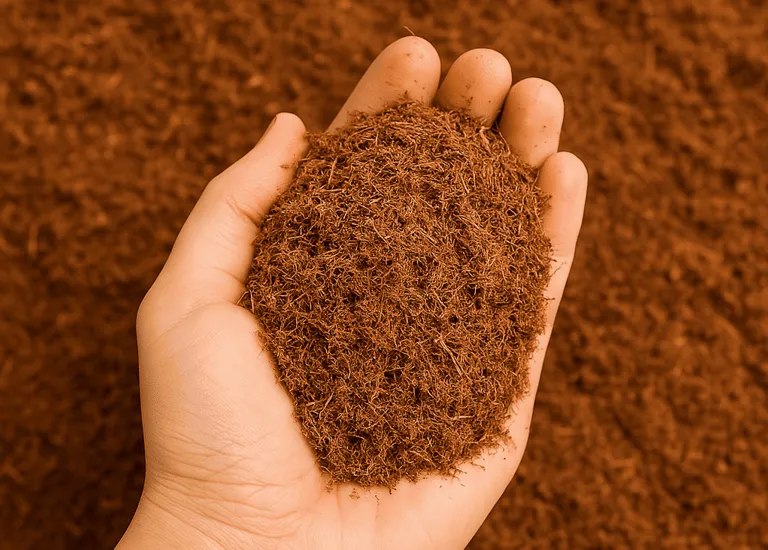
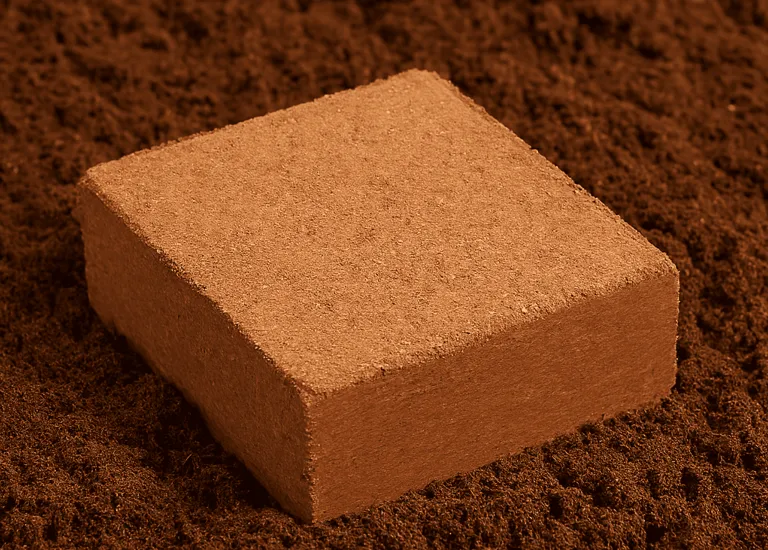
The short answer: a standard 5 kg compressed cocopeat block expands to roughly 65 to 75 litres of usable growing medium once fully hydrated — around a 5:1 expansion by volume. The exact figure moves with compression, moisture content and how you hydrate it, and getting the calculation right is the difference between ordering the correct volume and running short halfway through planting.
Why Cocopeat Is Compressed at All
Loose cocopeat is mostly air. Compressing it into blocks cuts shipping volume dramatically, which is why blocks dominate export and bulk orders — you are paying to move product, not air. A pallet of blocks carries several times the growing medium of a pallet of loose material.
The trade-off is the hydration step at your end. If you would rather skip it, loose cocopeat by the tonne is the alternative — we compare the economics in our guide to cocopeat blocks vs loose material.
Typical Yields by Block Size
These are common formats and their approximate hydrated volumes. Treat them as planning figures and confirm against the specification for the product you actually order:
| Block size | Approx. hydrated volume | Typical use |
|---|---|---|
| 650 g brick | ~8–9 litres | Retail, home gardening, small trials |
| 1 kg brick | ~13–15 litres | Small nurseries, hobby growers |
| 4.5–5 kg block | ~65–75 litres | The commercial standard — farms and nurseries |
| Jumbo bale | Several hundred litres | Container export, large-scale operations |
What Changes the Ratio
- Compression ratio — the main factor. A more heavily pressed block yields more per kilo of shipped weight but takes longer to break apart.
- Moisture content at packing — a block packed damp weighs more for the same amount of dry pith. You are paying for water, and it expands less per kilo than a properly dried block.
- Grade and particle size — fine pith packs denser than a coarse or chip-blended grade, so the two expand differently.
- Water temperature and volume — warm water and enough of it break the block down faster and more completely. Under-watering leaves a compressed core that never contributes to your final volume.
- Time — rushing it is the most common reason growers believe they were short-changed.
How to Hydrate a Block Properly
- Use a container bigger than you think you need — at least the expected final volume plus headroom.
- Add clean water in stages — roughly 20 to 30 litres for a 5 kg block, rather than all at once.
- Give it time — allow the block to absorb fully; large blocks take a while to reach the core.
- Break it up — turn and crumble the material as it softens so no compressed lump survives.
- Let it drain — before filling bags or trays, drain to a consistent moisture level so every container starts the same.
If you are using washed or buffered material, measure your water's own EC and pH first — it affects what you are actually starting with. See our guide to cocopeat EC and pH.
Working Out How Much to Order
The practical calculation for a fertigation or nursery crop:
- Decide your medium volume per plant — per polybag, grow bag or tray cell.
- Multiply by your plant count to get total litres required.
- Divide by the hydrated yield per block for your chosen format.
- Add a margin — 10% is sensible for settling, spillage and variation between batches.
Doing this before you order avoids the two classic outcomes: running short mid-planting, or paying to store a season's surplus.
Need help sizing an order? Tell us your crop, bag volume and plant count and S&S Coco Trading will work out the blocks or tonnage you need and quote it — see our coco blocks or message us on WhatsApp. Nationwide delivery from our Perlis factory, with export support for container loads.